Oppo Find X5 Pro Deals - October 2026
1 refurbished deal available - SIM-free from £1,399.00.

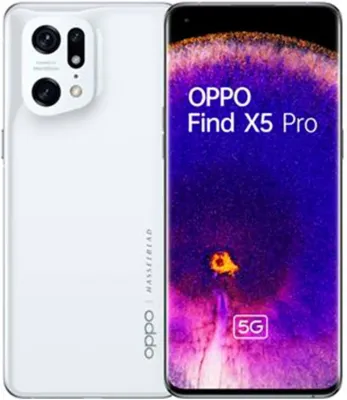
The Oppo Find X5 Pro is in our catalog but no UK retailer currently stocks it.
Release date: 14 March 2022
Color
All
Black
Storage
All
256GB
Photography-focused buyers who want flagship low-light results and very fast wired and wireless charging from an older handset, and who are relaxed about running software that is no longer being updated.
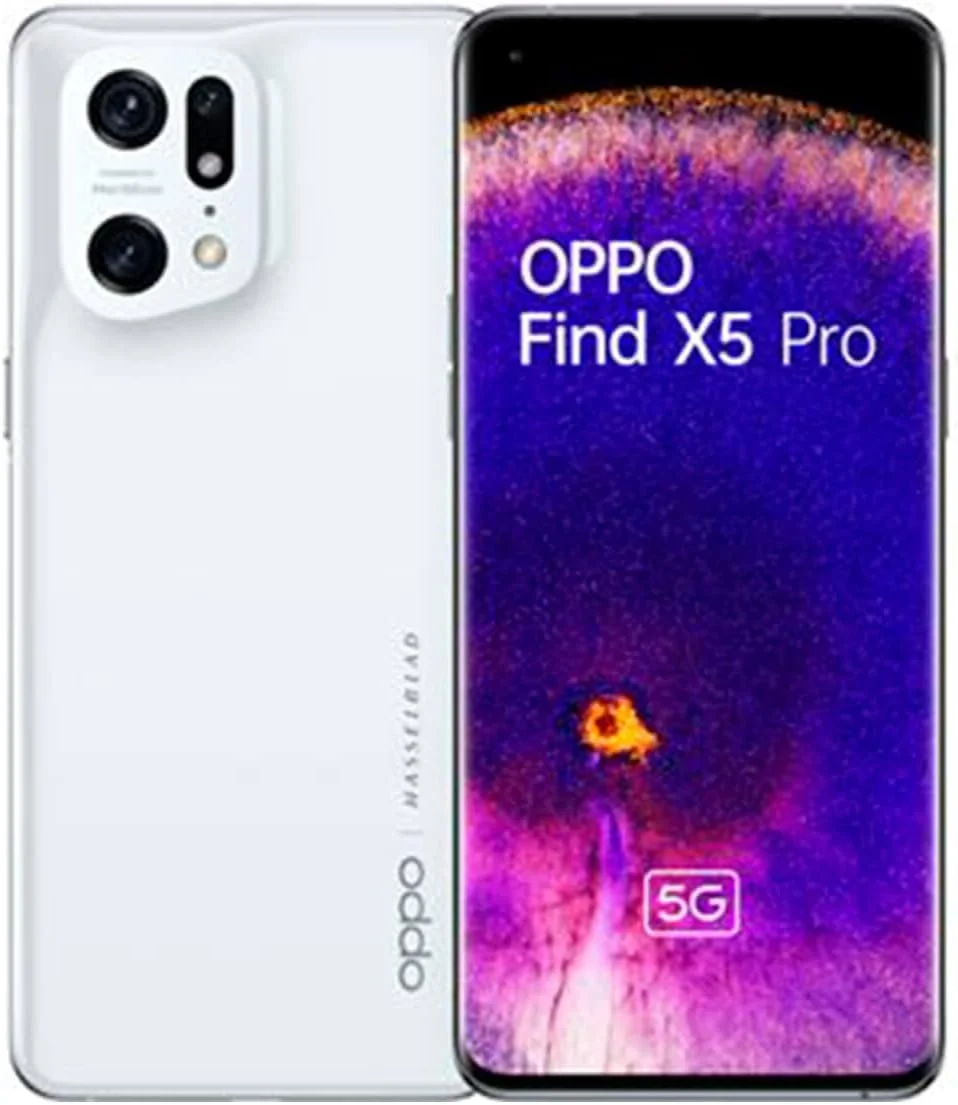
Cashback:
£0.00
Upfront Cost:
£1,399.00
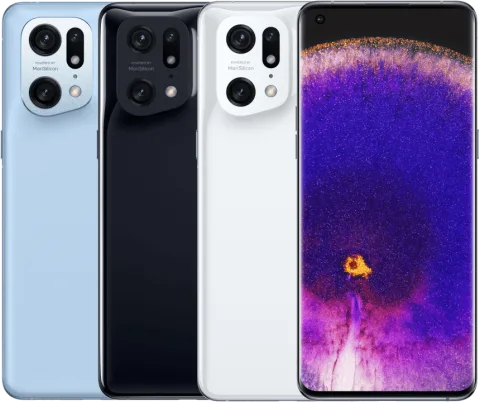
Images: Oppo
1 refurbished deal available - SIM-free from £1,399.00.
The Find X5 Pro was Oppo's most serious attempt at going toe-to-toe with Samsung's flagships, and four years on it holds up better than most phones of its era. The headline was MariSilicon X, an imaging chip Oppo designed in-house to handle noise reduction and 4K night video, and it still gives the twin 50MP Sony IMX766 sensors a genuine edge after dark that mid-range rivals of the period never matched. The Hasselblad partnership is more about colour tuning and a well-judged Pro mode than anything transformative. What ages best is everything around the camera: a 1440p LTPO panel that still looks superb, IP68 protection, a ceramic back that feels properly premium, and charging speeds that continue to embarrass far newer phones. The trade-offs are real, though. The Snapdragon 8 Gen 1 ran warm and is no longer a performance leader, the 13MP 2x telephoto is easily the weakest lens in the set, and at 218g this is a heavy phone. Software is the other caveat: it shipped on Android 12 and its update runway is essentially spent, so buy it for the imaging and the charging rather than for years of future support.
Tracking the best prices since 27 Apr 2026.
| Feature | Oppo Find X5 Pro | Oppo Find X5 |
|---|---|---|
| Display | 6.7-inch LTPO AMOLED, 3216×1440, 120Hz | 6.55-inch AMOLED, 2400×1080, 120Hz |
| Chipset | Snapdragon 8 Gen 1 plus MariSilicon X | Snapdragon 888 plus MariSilicon X |
| Battery | 5,000 mAh | 4,800 mAh |
| Charging | 80W wired, 50W wireless | 80W wired, 30W wireless |
| Water resistance | IP68 rated | No IP68 rating |
| Weight | 218 g | 196 g |
| Dimensions | 163.7 × 73.9 × 8.5 mm | 160 × 73 × 8.7 mm |
| SIM-free price | Not available | From £976.00 |
£700-£999 Phones · 85 phones
Based on calibrated CPU benchmark rankings (60%) and GFXBench GPU scores (40%). Apple chipsets included via editorial calibration since AnTuTu under-represents Apple's architecture.
Based on panel type (LTPO is the modern flagship gold standard), resolution, refresh rate, peak brightness, screen size, and HDR10+ / Dolby Vision support. Marketing peak-brightness claims are capped at 3500 nits to prevent inflation.
Lab-measured by DXOMARK (130 on their scale). The measured result replaces our spec-sheet estimate for this category.
Based on main-sensor size (1-inch / 1/1.3" beats 1/2.0"), telephoto reach (periscope > 5x > 3x optical), image processing tier (Apple Pro, Pixel Pro, Galaxy Ultra, Honor Magic Pro, Xiaomi Ultra), pro video features (ProRes, Apple Log, Dolby Vision), camera-partnership branding (Leica, Hasselblad, Zeiss) and OIS. Older flagships are de-rated since image processing pipelines have advanced significantly each generation. Megapixel count is deliberately downweighted — it correlates poorly with real-world camera quality. Where DXOMARK has lab-tested the phone, its measured score replaces this estimate.
Based on the image-processing tier (Apple Pro, Pixel Pro, Galaxy Ultra and Honor Magic lead on computational processing), sensor resolution in tiers rather than raw megapixels, autofocus, aperture and max selfie-video resolution. Calibrated against DXOMARK's selfie protocol.
Based on battery capacity (mAh) adjusted for platform efficiency calibrated against NotebookCheck, Tom's Guide, GSMArena and CNET reviewer tests. Apple A-series gets +45% (iOS process freezing + LTPO 1Hz + tuned panels make iPhone Pro Max outlast many 6500+ mAh Android phones in measured tests). Top Snapdragon / Dimensity flagships get +15%, budget chipsets are penalised −15% to −25% to reflect less efficient displays and looser background limits. Charging speed is excluded — see the separate Fast charging tag for that.
163.7 x 73.9 x 8.5 or 8.8 mm
218 g
Nano-SIM + eSIM
Android 12, up to Android 14, ColorOS 14
No
Ceramic Black, Ceramic White, Blue (eco leather)
50
4K@30/60fps, 1080p@30/60/240fps; gyro-EIS; HDR, 10‑bit video
50 MP, f/1.7, 25mm (wide), 1/1.56", 1.0µm, multi-directional PDAF, OIS (3-axis sensor-shift, 2-axis lens-shift) 13 MP, f/2.4, 52mm (telephoto), 1/3.4", 2x optical zoom, PDAF 50 MP, f/2.2, 15mm, 110˚ (ultrawide), 1/1.56", 1.0µm, multi-directional PDAF
Panorama
32 MP, f/2.4, 21mm (wide), 1/2.74", 0.8µm
2160
1080p@30fps, gyro-EIS
LTPO2 AMOLED, 1B colors, 120Hz, HDR10+, BT.2020, 500 nits (typ), 800 nits (HBM), 1300 nits (peak)
6.7
1440 x 3216 pixels, 20:9 ratio (~525 ppi density)
Corning Gorilla Glass Victus
Snapdragon 8 Gen 1
Adreno 730 - Global
Octa-core (1x3.00 GHz Cortex-X2 & 3x2.50 GHz Cortex-A710 & 4x1.80 GHz Cortex-A510) - Global
No
Yes, with stereo speakers
No
GSM 850 / 900 / 1800 / 1900
HSDPA 800 / 850 / 900 / 1700(AWS) / 1900 / 2100
1, 2, 3, 4, 5, 7, 8, 12, 13, 17, 18, 19, 20, 25, 26, 28, 32, 34, 38, 39, 40, 41, 42, 66 - Global
1, 2, 3, 5, 7, 8, 12, 13, 18, 20, 25, 26, 28, 38, 40, 41, 66, 77, 78, 79 SA/NSA - Global
HSPA, LTE, 5G
GSM / CDMA / HSPA / CDMA2000 / LTE / 5G
Wi-Fi 802.11 a/b/g/n/ac/6e, dual-band, Wi-Fi Direct
5.2, A2DP, LE, aptX HD
USB Type-C 3.1, OTG
Yes
GPS (L1), GLONASS (L1), BDS (B1I+B1c), GALILEO (E1+E5a), QZSS (L1)
5000
80W wired, PD, 50% in 12 min 50W wireless, 100% in 47 min 10W reverse wireless
Fingerprint (under display, optical), accelerometer, gyro, proximity, compass